The Baby, the Dancer, and the “Mother-Mania” Defense That Captivated a Nation

Carmen Sierra Kidnapped in 1929
Carmen Sierra’s kidnapping in 1929 and why the streets of New York never truly slept. Elevated trains rattled through Brooklyn long after midnight. Newspaper boys shouted headlines beneath flickering lamps. Puerto Rican families crowded into small apartments, building new lives in a city that often viewed them as outsiders. It was an era of jazz, immigration, poverty, and survival. And then, one spring afternoon, terror struck a Puerto Rican family in Manhattan. A baby vanished.
The disappearance of little Carmen Sierra ignited fear throughout New York’s Puerto Rican community and became one of the most emotionally charged child abduction cases of its time. What began as a family tragedy soon evolved into something much larger: a psychological mystery that fascinated journalists, police detectives, physicians, and ordinary readers across America. Why would a woman steal a child? That haunting question dominated headlines after Carmen’s disappearance, eventually inspiring a full-page Sunday feature in the Daily News titled ‘Why Do Women Kidnap Children?’
Published on December 1, 1929, the article tried to explain female child abductions through the language of its time: grief, loneliness, infertility, maternal obsession, and what the press called ‘mother mania.’ For readers in 1929, the Carmen Sierra kidnapping was more than sensational news. It was every parent’s
nightmare. “This was not only a kidnapping story. It was a story about a stolen child, a
devastated family, and a city trying to explain the unthinkable.”
Why Do Women Kidnap Babies?
In a full-page feature published on December 1, 1929, the Daily News attempted to answer a question that haunted parents across America after the kidnapping of baby Carmen Sierra: “Why do women kidnap children?” The article argued that female child abductors were rarely motivated by revenge or financial gain. Instead, the newspaper claimed that most women who stole children were driven by overwhelming emotional and psychological impulses tied to motherhood. According to the article, it was often the “pale, sickly” children who were targeted rather than the healthiest infants, because these children awakened what the newspaper described as an “irresistible desire” within emotionally troubled women to care for and protect them.
Brooklyn police Captain Ayres referred to this phenomenon as “mother mania,” a phrase repeatedly used throughout the article. Drawing upon his years of experience investigating kidnappings, Ayres argued that women who abducted children were frequently suffering from loneliness, grief, or delusions connected to motherhood. He stated that, in his opinion, nearly every female kidnapping case he encountered stemmed from a desperate emotional longing to possess and care for a child. Ayres contrasted these cases with the rare examples of kidnappings motivated by revenge or violence, such as the notorious Marion Parker murder case involving Winnie Ruth Judd.
High Profile Kidnappings
The article referenced several high-profile child abduction cases to support its theory. Among them was the disappearance of Billy Gaffney, a Brooklyn child who vanished on Christmas Day and was never found. Another case involved six-month-old Maria Arias, described in the article as frail and underweight, who disappeared from a baby carriage outside a store. The newspaper emphasized that these abducted children were often physically weak or sickly, reinforcing the belief that kidnappers were acting out of distorted maternal instincts rather than cruelty alone.
Betty Moore and her involvement with Carmen Sierra
Central to the article was the case of Betty Moore, the woman who confessed to kidnapping one-month-old Carmen Sierra from outside a crowded New York store. Moore, identified as a Hawaiian hula dancer, reportedly told investigators that she stole the infant because Carmen reminded her of her own baby daughter who had died. “I took her because she looked so much like my baby,” Moore explained. According to the article, Moore and her husband had desperately wanted another child after the death of their daughter, and this grief allegedly fueled her actions.
Despite the trauma inflicted upon Carmen Sierra’s family, Captain Ayres argued that women who kidnapped children often cared for them attentively once they were taken. He claimed that abductors commonly fed, clothed, and even sought medical care for the children in their custody. Ayres pointed to the Carmen Sierra case itself, noting that the baby appeared healthy after being recovered from Betty Moore. The article portrayed these women not as hardened criminals, but as emotionally unstable individuals consumed by maternal obsession and psychological distress.
Summary
The Daily News concluded by warning parents that child abductions could happen anywhere and urged families to fingerprint or footprint infants shortly after birth to aid future identification efforts. Beneath its sensational headlines, the article revealed the fears and social attitudes of 1929 America — a society struggling to understand female criminality, mental health, grief, infertility, and the emotional devastation caused by the kidnapping of a child. For many readers, the Carmen Sierra case was more than a crime story. It became a deeply emotional symbol of parental fear and a disturbing attempt to explain the unthinkable.
April 29, 1929: The Day Carmen Vanished
On April 29, 1929, Frank Sierra and his wife, Agar Sepulveda Sierra, entered the J. G. McCrory five-and-ten-cent store at 218 West 125th Street in Harlem. Their infant daughter, Carmen Sierra, was left in her carriage outside the store, a common practice in the era’s crowded shopping districts. Moments later, the carriage was empty. Contemporary accounts place the kidnapping at approximately 2:15 in the afternoon. The Sierra family lived at 510 West 124th Street, only a short distance from the store. Early newspaper reports described Carmen as either seven weeks old or seven months old, a discrepancy repeated in several captions and wire stories. The court and New York Times accounts identified her as seven weeks old, and that age is used here unless discussing a specific newspaper caption.

Detectives immediately suspected the infant had been lifted from the carriage while her parents were inside. Witnesses spoke of suspicious movement around the store. One trail led police toward a mysterious ‘woman in black,’ while another report described a possible route through Manhattan streets toward transportation lines. Newspaper maps turned the investigation into a public puzzle, tracing where the baby might have been carried after the abduction.
Emotional Distress takes its toll
The emotional devastation was immediate. Newspapers reported that Agar Sierra collapsed in grief, while
Frank Sierra, already suffering from heart trouble, was said to have been physically shaken by the shock. A
widely circulated photograph showed Frank trying to comfort his wife beside the empty baby carriage. The image needed no embellishment. It was a portrait of parental terror.

Harlem Panic and the Fear of a Kidnap Ring
Within forty-eight hours, the case had taken on a life of its own. Newspapers warned that Harlem parents
feared a kidnapping ring. The idea that infants might be targeted in crowded shopping districts spread quickly through the city. In the Puerto Rican and immigrant neighborhoods of Manhattan, the fear was especially intense. Families already living with uncertainty, economic pressure, language barriers, and discrimination now faced a more primal fear: that a child could disappear in daylight from a busy street. Mothers watched baby carriages more closely. Strangers drew suspicion. Every rumor mattered, every sighting carried hope, and every hour without Carmen deepened the dread.
A City Captivated by Fear
By the late 1920s, child kidnappings had become front-page material in New York newspapers. Yet the
Carmen Sierra’s case struck a particularly emotional nerve because Carmen was not the child of wealthy elites or famous socialites. She belonged to a hardworking Puerto Rican family trying to survive in New York during one of the most difficult economic periods in American history. As newspapers competed for readers, reporters transformed the investigation into a daily drama filled with rumors, emotional testimony, possible witnesses, and psychological speculation. Detectives chased leads across boroughs while the public anxiously followed every detail. The question grew more disturbing with each day: had Carmen been taken by a stranger, by an organized ring, or by someone whose motive was more personal and more psychologically complex?
Betty Moore: The Woman Who Took Carmen

The woman at the center of the case was Mrs. Betty Moore, a 23-year-old Hawaiian dancer and former showgirl who had appeared in vaudeville productions. Police arrested her in a Brooklyn rooming house at 234 South Ninth Street after Detectives Gassman and Jenner, acting on information received earlier that day, entered her room and found her rocking baby Carmen to sleep in a newly purchased cradle.
The scene was almost surreal. While New York searched frantically for a kidnapped infant, the accused woman sat quietly with the child as though she were an ordinary mother putting her baby to bed.
At first, Moore insisted Carmen was her own child. Under questioning, she finally confessed. She told
police that she had passed the McCrory store on West 125th Street and noticed the baby lying in the carriage. Carmen reminded her of her own daughter, Agnes, who had died years earlier at the age of one.
Moore’s explanation chilled the public because it did not read like a calculated ransom plot. It sounded like obsession.
The Story Betty Moore Told Police

According to the account attributed to her, Moore said she had been born in Moundsville, West Virginia, to Hawaiian parents. At eighteen, she married an actor named Grandon Moore, who later deserted her around the time her daughter was born. She said she had then worked as a dancer, was arrested on a charge described in the press as infidelity, and was sentenced to seven months in county jail.
Moore claimed she escaped a month later, went to Cleveland, joined a company of Hawaiian dancers, and
eventually came to New York about two years before Carmen’s kidnapping.
On the day of the abduction, she said, she first stopped only to kiss the baby. Then, according to her
statement, ‘mother love’ became too strong. When she realized no one appeared to be watching, she hid Carmen under her coat and carried her away. Moore first took the child to a rooming house where she had been living on West 123rd Street. The following day, she moved to Brooklyn and brought Carmen with her. Perhaps the most haunting detail came when detectives asked whether Moore had read the newspaper accounts of the kidnapping. She said she had purposely avoided the papers because she feared reading something that might cause her to lose the child.
Carmen Is Found

As the investigation moved into the courts, the story became even more complicated. In Harlem Court, Betty Moore pleaded guilty to kidnapping Carmen Sierra and waived examination before Magistrate McKiniry. She was held without bail for the grand jury. But Moore was not alone before the judge. Arraigned beside her was Joseph Sutton, a Brooklyn salesman who had been arrested with Moore in the furnished room where Carmen was found. Newspaper accounts gave Sutton’s age as thirty-six or thirty-seven and his address as Havemeyer Street in Brooklyn, with slight variations in the house number across reports.
Prosecutors accused Sutton of acting in concert with Moore. Unlike Moore, Sutton pleaded not guilty and
denied knowledge of the kidnapping. He also waived examination and was held for the grand jury.
The newspapers seized on the contrast. Moore appeared emotionally broken and confessed to taking the child. Sutton remained guarded, denying involvement. Was he merely present when police arrived, or had he helped hide Carmen while the city searched? The papers left readers suspended between fact and suspicion.
Indictment and Public Judgment
The legal process continued to move quickly. The New York County Grand Jury eventually indicted Betty
Moore and Joseph Sutton on a kidnapping charge. The indictment was reported as having been handed to Judge Otto A. Rosalsky in General Sessions.
The indictments showed how seriously authorities treated the crime. New York was already anxious about child disappearances, and the Sierra case had exposed how vulnerable families felt in crowded urban neighborhoods. Yet public opinion remained conflicted. Some readers viewed Moore as a dangerous criminal. Others saw her as a psychologically broken woman destroyed by grief. Newspapers often encouraged both interpretations at once, using language that condemned her act while inviting readers to pity her loss.
The Second Baby Theft Question
The story grew darker when newspapers connected Moore to questions about another baby theft. A later Daily News article reported that Moore was being questioned in connection with a second infant disappearance. The headline called her a ‘girl dancer’ and framed the investigation as a possible second baby-theft case. This angle changed the public’s understanding. Was Carmen’s kidnapping a single grief-driven act? Or had Moore done this before? The papers did not provide a final answer in the clippings gathered here, but the suggestion alone intensified public fear. Parents who first imagined one unstable woman now wondered whether there were more missing children, more stolen babies, and more secrets hidden in furnished rooms across the city
A Bath and Then Home

When Carmen recovered, newspapers across the country rushed to publish photographs of the child
alive and safe. One image became especially unforgettable. In the photograph, little Carmen sits in a hospital bath following a physical examination, staring uncertainly toward the camera while nurses prepare her to return home. The caption read: ‘A Bath and Then Home.’ Another newspaper imagined what the infant might say if she could speak: ‘Goin’ Home, I’m So Happy.’
The image transformed Carmen from a newspaper mystery into a real child again. Not a headline, evidence, or a symbol. Just a baby finally going home. For Frank Sierra and Agar Sepulveda Sierra, the return of their daughter did not erase the horror of those missing days. Their baby had been alive, but unreachable. Loved, but stolen. Protected, but by the very person who had caused their suffering. “This was not only a kidnapping story. It was a story about a stolen child, a devastated family, and a city trying to explain the unthinkable.”
The Headlines Spread Across America
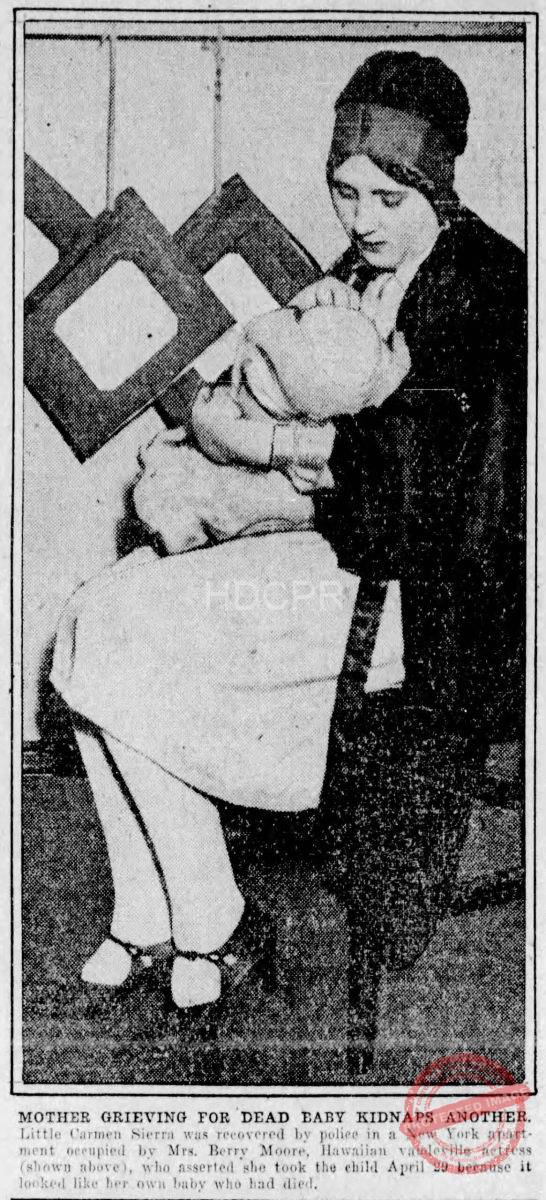
What began as a local Harlem kidnapping rapidly became national and even international news. Newspapers from Brooklyn to Cleveland, Arizona to Ontario carried the strange and emotionally charged story of Betty Moore and baby Carmen Sierra. The language of the headlines reveals the era’s fascination with psychology, motherhood, and feminine emotional instability. One Canadian newspaper ran the enormous headline ‘Mother Love Too Strong.’ Another paper showed Moore cradling Carmen beneath a caption that described her as a mother grieving for a dead baby who kidnapped another. The images told a disturbing visual story.
In some photographs, Moore appears almost tender, holding Carmen close against her chest. In others, Carmen appears frightened, exhausted, or confused. The public consumed every image, every confession, every court appearance, and every rumor. Long before television, true-crime documentaries, or social media, newspapers created national drama through headlines, photographs, and emotional storytelling. The Carmen Sierra kidnapping became not only a
criminal case, but a national psychological spectacle.
The Psychology of “Mother Mania”
Modern readers may find the terminology harsh or outdated, but in 1929, psychiatrists and newspaper writers often described compulsive maternal behavior with phrases such as ‘mother mania.’ The December 1929 Daily News feature attempted to understand why women kidnapped children, suggesting that many were driven not by profit or revenge but by grief, loneliness, infertility, or emotional shock connected to motherhood. The article described women who had lost children, suffered miscarriages, fabricated pregnancies, or developed obsessive maternal fixations. It also noted that some abductors cared for the stolen babies tenderly, making their crimes more difficult for the public to categorize.
In that framework, Betty Moore became a chilling example. She did not demand ransom. She did not
abandon Carmen. Instead, she tried to create a false motherhood around a stolen infant. Today, we would be cautious about accepting the medical language or assumptions of 1929. The newspapers often simplified women’s trauma and sensationalized mental illness. Still, the coverage reveals how strongly the public tried to explain the unthinkable: a woman stealing another mother’s baby in order to fill the emptiness left by her own.
The Final Chapter: “Mother-Mania Plea Vain; Dancer Jailed”
By the summer of 1929, the Carmen Sierra kidnapping case had already consumed newspapers across America. The public had followed every development — the frantic search through Harlem, the shocking discovery of Carmen in Brooklyn, Betty Moore’s confession, and the emotional courtroom proceedings.
But the final chapter of the case would prove to be one of the most revealing. On July 25, 1929, the Daily News published a dramatic headline: “MOTHER-MANIA PLEA VAIN; DANCER JAILED.”
In the final chapter of the kidnapping of little Carmen Sierra, the defense attempted to portray Betty Moore not as a hardened criminal, but as a grieving mother driven to emotional collapse. Newspapers across New York repeatedly described her condition as “mother mania,” a phrase used at the time to explain what attorneys argued was an overwhelming maternal obsession brought on by the death of her own infant daughter, Agnes. According to the defense, Moore’s grief had become psychologically consuming, leaving her unable to resist taking baby Carmen after seeing the child asleep outside the McCrory store in Harlem.
Her attorneys insisted that Betty Moore had not acted out of greed, cruelty, or any desire for ransom. Instead, they argued that she desperately longed to become a mother again. Newspapers described her as emotionally shattered by the loss of her child and unable to cope with the emptiness left behind. Even Moore’s father, identified as Rev. J. B. Grandon of Jefferson, Pennsylvania, personally appealed to the court for mercy, writing a heartfelt letter to the judge in hopes of saving his daughter from severe punishment.
The Plea Failed
Judge George L. Donnellan rejected the so-called “mother-mania” defense and sentenced Betty Moore — also identified in some reports as Belle Grandon Moore — to the Bedford Reformatory. With that decision, one of New York’s strangest and most emotionally complex kidnapping cases officially came to an end.
Yet the public remained deeply unsettled by the contradictions surrounding the crime. Contemporary newspapers noted that baby Carmen Sierra appeared healthier when she was recovered than when she had been abducted. Detectives reported that Moore had carefully fed the infant, purchased new clothing for her, called physicians whenever the child became ill, and transformed a furnished room in Brooklyn into what amounted to a stolen nursery.
That contradiction haunted public opinion in 1929.
Betty Moore had undeniably committed a terrible crime. But the newspapers also portrayed her as a grieving mother attempting to recreate the child she had lost. The kidnapping of Carmen Sierra forced Americans to confront an uncomfortable reality: not every kidnapper appeared monstrous. Some looked heartbreakingly human.
Carmen Sierra: More Than a Headline
Lost beneath the sensational headlines was the suffering of Carmen Sierra’s family. For Puerto Rican
families in New York, the case was deeply personal. The Sierra family represented thousands of migrants who had left Puerto Rico seeking opportunity yet found themselves navigating discrimination, crowded housing, language barriers, and economic struggle. The kidnapping shattered any sense of safety. Parents became fearful in crowded streets and department stores. Mothers watched carriages with new suspicion. Rumors spread rapidly through Puerto Rican neighborhoods. The newspapers focused on the investigation and the kidnapper’s psychology. But behind every article was a grieving mother unable to sleep, a father searching endlessly for answers, and a community praying for the child to return.
Why the Carmen Sierra Case Still Matters
Nearly a century later, the Carmen Sierra kidnapping remains hauntingly relevant. It reflects the power of
newspapers during the golden age of print journalism, the social struggles faced by Puerto Rican migrants in New York, and the complex psychological questions surrounding child abduction and grief.
It also reminds us that historical crime stories should not be remembered only for their sensational details. Carmen was not a plot device in a newspaper drama. She was a child. Frank and Agar were not merely grieving figures in a photograph. They were parents living through terror. More than a sensational crime story, the kidnapping of Carmen Sierra survives as a deeply human tragedy involving fear, loneliness, motherhood, immigration, survival, and the fragile line between grief and obsession.
Archival Note on Conflicting Details
The surviving newspaper accounts do not always agree. Carmen’s age appears as seven weeks in court and New York Times accounts, while some captions describe her as seven months old. Joseph Sutton’s age and address also vary slightly across reports. Rather than erase these differences, this article treats them as part of the archival record and prioritizes the most specific courtroom and police-based accounts when establishing the main narrative.
Sources Consulted
The following archival newspaper items were used to reconstruct the article. Some details vary across
contemporary reports; differences are noted in the article where relevant.
- Brooklyn Eagle — Apr. 30, 1929, p. 13, “Fail to Get Trace of Baby Kidnaped in Shopping Crowd.” Daily News
- May 1, 1929, front page and p. 3, Carmen Sierra kidnapping coverage. Daily News
- May 2, 1929, “New Harlem Kidnap Trail Leads to Woman in Black.”
- The New York Times — May 1929, coverage of Betty Moore’s arrest and confession in the Carmen Sierra case, as transcribed from the clipping provided by the researcher.
- The Brooklyn Citizen — May 9, 1929, p. 2, “The Baby She Kidnaped.”
- The Buffalo News — May 9, 1929, p. 1, “Kidnaped Infant Found.”
- The Standard — May 9, 1929, p. 33, “Mother Love Too Strong.”
- The Plain Dealer — May 11, 1929, p. 28, “Mother Grieving for Dead Baby Kidnaps Another.”
- San Francisco Call-Bulletin — May 14, 1929, image caption “A Bath and Then Home.”
- Tucson Citizen — May 15, 1929, p. 7, Carmen Sierra recovery photograph caption.
- Times Union — May 16, 1929, p. 75, “Couple Indicted for Theft of Baby.”
- Poughkeepsie Eagle-News — May 17, 1929, p. 8, Carmen Sierra and Betty Moore photo feature.
- Daily News — May 28, 1929, p. 466, “Quiz Girl Dancer on 2d Baby Theft.”
- Daily News — Dec. 1, 1929, p. 546, “Why Do Women Kidnap Children?”
The Genealogy of Carmen Sierra Sepúlveda
This family tree reflects the deep Puerto Rican roots of the Sierra Sepúlveda family and preserves the memory of generations whose lives spanned the towns of Peñuelas, Sabana Grande, San Germán, San Juan, Ponce, and New York. Through these ancestral lines, the story of Carmen Sierra Sepúlveda becomes part of a larger historical narrative connecting migration, family, and heritage across Puerto Rico and the Puerto Rican diaspora in New York City.

Generation 1
1. Carmen Sierra Sepúlveda
Born on March 11, 1929, in New York.
Died on September 29, 1979, in Ponce, Puerto Rico.
Generation (Parents)
2. Francisco Sierra y Meri
Born c. 1903 in Peñuelas, Puerto Rico.
3. Judith Agar Sepúlveda Quiñones
Born September 1, 1894, in Sabana Grande, Puerto Rico.
Died July 29, 1970, in Peñuelas, Puerto Rico.
Generation 3 (Grandparents)
4. Don Juan Sierra y Pérez
Born c. 1857 in Peñuelas, Puerto Rico.
Died November 14, 1923, in Peñuelas, Puerto Rico.
5. Carmen Meri y Torres
Born c. 1859 in Peñuelas, Puerto Rico.
Died December 16, 1925, in Peñuelas, Puerto Rico.
6. Don Manuel J. Sepúlveda
Born c. 1867 in Sabana Grande, Puerto Rico.
Died February 14, 1946, in Sabana Grande, Puerto Rico.
7. María Quiñones y Quiñones
Born c. 1870 in Sabana Grande, Puerto Rico.
Died April 14, 1944, in San Juan, Puerto Rico.
Generation 4 (Great-Grandparents)
8. Don Juan Evangelista Sierra y Planas
Born c. 1820 in Peñuelas, Puerto Rico.
Married on June 4, 1840, in Peñuelas, Puerto Rico.
9. Doña Francisca Pérez y Rosales
Born c. 1822 in Peñuelas, Puerto Rico.
10. Pedro José Meri y Montalvo
Born c. 1818 in Coto, Peñuelas, Puerto Rico.
Died November 16, 1893, in Peñuelas, Puerto Rico.
11. Bernardina Torres y Lugo
Born c. 1832 in Peñuelas, Puerto Rico.
Died April 18, 1895, in Peñuelas, Puerto Rico.
13. Elenteria Sepúlveda
Born c. 1845 in Sabana Grande, Puerto Rico.
15. Doña Cantura Quiñones y Álvarez (RDA* connection, see below.)
Born c. 1854 in San Germán, Puerto Rico. She died March 8, 1909, in Sabana Grande, Puerto Rico.
Ramírez de Arellano Connection
Ancestors of Don José Policarpio de Quiñones y Ramírez de Arellano
Don José Policarpio de Quiñones y Ramírez de Arellano, son of Nicolás de Quiñones y Ramírez de
Arellano and María del Carmen Ramírez de Arellano y de Quiñones were born about 1822 in San
Germán, Puerto Rico. He died on 23 Mar 1896 in Sabana Grande, Puerto Rico. He married Doña
Eusebia Álvarez. She was born about 1816 in San Germán, Puerto Rico. She died on 27 Nov 1903 in
Sabana Grande, Puerto Rico.
- Source: Civil Registration Record of Deaths, Sabana Grande, Puerto Rico
Parents
Don Nicolás de Quiñones y Ramírez de Arellano was born about 1768 in Villa de San Germán, Puerto Rico. He died on 21 May 1830 in San Germán, Puerto Rico. He married Doña María del Carmen Ramírez de Arellano y de Quiñones on January 25, 1802, in Villa de San Germán, Puerto Rico
- Source for marriage: Actas Sacramentales de la Villa de San Germán 1759-1850, by Dennis de Jesús Rodríguez. They had un 2.º con 3.er grado de consanguinidad y un 3.er. Grado de consanguinidad, page 189.
Doña María del Carmen Ramírez de Arellano y de Quiñones, daughter of Regidor Don Ramón Ramírez de Arellano y Quiñones and Doña Rosa María De Quiñones y Yrizarry, was born about 1780 in Villa de San Germán, Puerto Rico. She died sometime after 1872.
Paternal Grandparents
Captain Miguel Felipe Martín de Quiñones González de Mirabal was born about 1725 in San Germán, Puerto Rico. He died on May 21, 1810, in San German, Puerto Rico. He married Doña María de Gracia Ramírez de Arellano y de la Seda, who was born about 1726 in San Germán, Puerto Rico. She died on October 15, 1771, in San Germán, Puerto Rico.
- Source: Actas Sacramentales de la Villa de San Germán 1759-1850, by Dennis de Jesús Rodríguez. pg. 352, 317
Maternal Grandpaents
Don Ramon Ramírez de Arellano Y Quiñones, Regidor, was born after 1760 in Villa de San Germán,
Puerto Rico. He died on an unknown date in Villa de San Germán, Puerto Rico. He married Rosa Maria De
Quiñones Y Yrizarry.
Doña Rosa María de Quiñones y Yrizarry was born about 1768 in San Germán County, Puerto Rico. She died on November 5, 1826, in San Germán County, Puerto Rico.
- Source: Actas Sacramentales de la Villa de San Germán 1759-1850, by Dennis de Jesús Rodríguez, 1825-1828, page 368.
Additional Sources of my investigation
If anyone reading this needs a specific source, please email me, and I will gladly provide it to you. Click
All photos have been restored using AI. But they are as close to the original as possible.